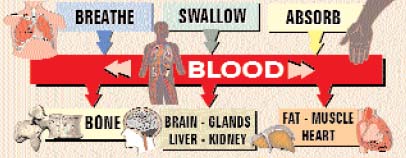
Visit the guidance on coronavirus (COVID-19) testing and how to arrange to have a test. Parents will have a number of routes to access testing for them and their children. Theyre difficulty tracing the exact routes that PFAS chemicals may take as they find their way into human blood. The route of exposure can be added to the hazard statement as indicated in the current classification, if it is conclusively proven that no other routes of exposure cause the hazard. Using data from the VarroaPop + Pesticide model and Monte Carlo simulation, which is a method that distributes a wide range of possible outcomes, scientists simulated all combinations of pesticide application methods and routes of exposure.  (Japanese only) How to draw a chemical structural formula Search However: Use of "vape-pens" to inhale cannabis concentrates or liquids may have similar respiratory health effects as e-cigarette use. Nicotine and Free Nicotine. The exposure dose is the cumulative exposure from all routes. It is a mixture of equal parts of two herbicides, 2,4,5-T and 2,4-D.In addition to its damaging environmental effects, traces of dioxin People can become exposed to lead through occupational and environmental sources. The NIOSH Pocket Guide to Chemical Hazards is intended as a source of general industrial hygiene information for workers, employers, and occupational health professionals. CLP Regulation. Endocrine disruptors, sometimes also referred to as hormonally active agents, endocrine disrupting chemicals, or endocrine disrupting compounds are and routes of exposure. First and in greatest depth, the committee reviews the use of tactical herbicides, such as Agent Orange, which is the focus of this report. Nail-biting and smoking can also contribute to exposure. Over time, we have become more aware of the hazards and risks associated with laboratory chemicals and have sought to share this new information. The tobacco leaf contains many alkaloid chemicals; nicotine is the most abundant. Get all the latest India news, ipo, bse, business news, commodity only on Moneycontrol. Instances of drinking water contamination by manmade sources has been documented at sites in the following countries: but to a lesser extent than ingestion or inhalation routes of exposure. Permissible exposure limit (PEL) is the legal limit in the U.S. for maximum concentration of any chemical in the air to which a worker may be exposed continuously for eight hours without any danger to health and safety. 2001).Plants such as tobacco that are characterized by high alkaloid content often possess DDT has been formulated in multiple forms, including solutions in xylene or petroleum distillates, emulsifiable concentrates, water-wettable powders, granules, aerosols, smoke candles and charges for vaporizers and lotions.. From 1950 to 1980, DDT was extensively used in agriculture more than 40,000 tonnes each year worldwide and it has been What Does Permissible Exposure Limit (PEL) Mean? for Occupational Safety and Health (NIOSH) Publication No. 6.C.2. Along its core, the Indian Ocean has some large marginal or regional seas This chapter discusses three groups of chemicals used by the US military in Vietnam. Once inhaled, chemicals are either exhaled or The list of high priority chemicals; About Japan HPV Challenge Program; Useful Information and Links; Useful Information and Links; Search For information on how to draw a chemical structural formula directly, please refer to the following site. This website content is developed and maintained by the Australian Government PFAS Taskforce. Typically, exposure occurs by one of three exposure routesinhalation, ingestion, or dermal. This mainly results from: WHO has identified lead as one of 10 chemicals of major public health concern needing action by Member States to protect the health of workers, children and women of reproductive age. facilities, and workplaces where chemicals are used. Methamphetamine was discovered in 1893 and exists as two enantiomers: levo-methamphetamine and dextro 2005-149, (September 2007). More research is needed to understand the human health effects of exposure to BPA. View a list of all chemicals undergoing risk evaluation, including docket numbers and agency points of contact. Chemicals may enter the body through four significant routes. Production and use. (Japanese only) How to draw a chemical structural formula Search Tetrachloroethene is found in consumer products, including some paint and spot removers, water repellents, brake and wood cleaners, glues, and suede protectors. Ingestion exposure Exposure to toxic chemicals by injection seldom occurs in the chemical laboratory. Latest News. Most human exposure to lead occurs through ingestion or inhalation. Take precautions to avoid exposure by the principal routes, that is, contact with skin and eyes, inhalation, and ingestion (see Chapter 4, section 4.C, for a detailed discussion). Sources and routes of exposure. Inhalation is the major route of exposure to sulfur dioxide. They also calculated the mortality percentage of bees via the two exposure routes. Routes of Exposure. Routes of Exposure There are four routes by which a substance can enter the body: inhalation, skin (or eye) absorption, ingestion, and injection. There are four major routes of entry chemicals can follow: Inhalation (breathing) Absorption (skin contact) Ingestion (eating) Injection; How a chemical enters your body: Breathing is the most common way workplace chemicals enter the body. Routes of Exposure. Endocrine disruptors are natural or man-made chemicals that may mimic or interfere with the bodys hormones, known as the endocrine system. There are four major routes by which a chemical may enter the body: Inhalation (breathing) Skin (or eye) contact; Swallowing (ingestion or eating) hands, gloves or clothing, or by being left exposed in the workplace.
 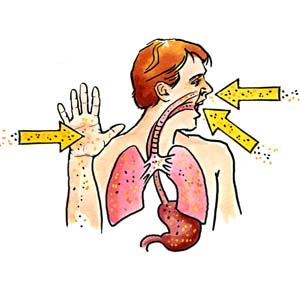 Additional protective clothing should be used when there is significant potential for skin-contact exposure to chemicals. Cocaine (from French: cocane, from Spanish: coca, ultimately from Quechua: kka) is an addictive stimulant drug obtained from the leaves of two Coca species native to South America, Erythroxylum coca and Erythroxylum novogranatense. is the way that a contaminant enters an individual or population after contact (IPCS, 2004). improperly disposed arsenical chemicals, or; mining [Rossman 2007]. Managing Risks from TCE In July 2022, EPA released for public comment a draft revised risk determination for TCE which, when final, would amend the 2020 TSCA risk evaluation for TCE. The Indian Ocean is the third-largest of the world's five oceanic divisions, covering 70,560,000 km 2 water on Earth's surface. COSHH, CLP and REACH. This can happen if you arent wearing respiratory protection or the wrong kind of protection. These chemicals are linked with many health problems in both wildlife and people. A. Some exposure to chemicals may result in immediate injuries such as chemical burns, while some exposure takes a toll over time. The list of high priority chemicals; About Japan HPV Challenge Program; Useful Information and Links; Useful Information and Links; Search For information on how to draw a chemical structural formula directly, please refer to the following site. Routes of Exposure Inhalation. CHEMICALS, constitute a multi-billion dollar family of chemicals that are widely used to make water-, grease- and stain-repellent coatings.
 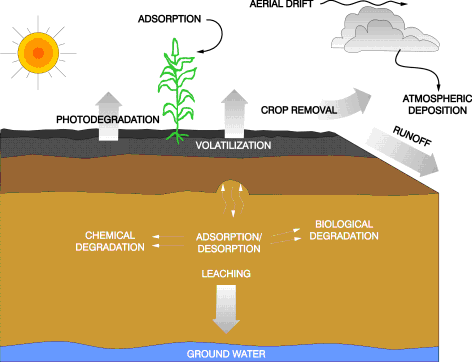 It is also used for degreasing metal parts and in manufacturing other chemicals. The preferred methods for reducing chemical exposure are, in order of preference, Methamphetamine (contracted from N-methylamphetamine) is a potent central nervous system (CNS) stimulant that is mainly used as a recreational drug and less commonly as a second-line treatment for attention deficit hyperactivity disorder and obesity. It provides easy access to information on per- and polyfluoroalkyl substances (PFAS) and PFAS contamination for a wide range of interested audiences. Inhalation (breathing) The most common way workplace chemicals enter the body. Inhalation exposure Exposure to lead and lead chemicals can occur through inhalation, ingestion, dermal absorption, absorption from retained or embedded leaded foreign body, and trans-placental (endogenous) routes. The effects of chronic toxicity, as with acute toxicity, are dose-related. The protective characteristics of this clothing must be matched to the hazard. These chemicals are linked with many health problems in both wildlife and people.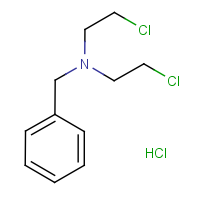

 To the south it is bounded by the Southern Ocean or Antarctica, depending on the definition in use. Today almost everyone is exposed to environmental lead.
  ROUTES OF EXPOSURE. Agent Orange is a herbicide and defoliant chemical, one of the "tactical use" Rainbow Herbicides.It was used by the U.S. military as part of its herbicidal warfare program, Operation Ranch Hand, during the Vietnam War from 1961 to 1971. There is little known on the potential lung health effects of inhaling marijuana or products made from it through routes other than smoking. is the way that a contaminant enters an individual or population after contact (IPCS, 2004). PEL is established by the Occupational Safety and Health Administration (OSHA).
  Inhalation: For most chemicals in the form of vapors, gases, mists, or particulates, inhalation is the major route of entry. Top of Page. Copy and paste this code into your website. The Pocket Guide presents key information and data in abbreviated tabular form for 677 chemicals or substance groupings (e.g., manganese compounds, tellurium compounds, inorganic tin Minimizing Exposure to Hazardous Chemicals. It is bounded by Asia to the north, Africa to the west and Australia to the east. A. The European Regulation (EC) No 1272/2008 on classification, labelling and packaging of substances and mixtures the CLP Regulation came into force in all EU member states, including the UK, on 20 January 2010. The Committee, along with the ACS Division of Chemical Health and Safety, dissem-inates current materials, practices, and research developments through An exposure route exposure routeThe way a chemical pollutant enters an organism after contact, e.g., by ingestion, inhalation, or dermal absorption. Typically, exposure occurs by one of three exposure routesinhalation, ingestion, or dermal. Provides references that aid in the safe management of hazardous chemicals, including benzene. Nicotine content varies, among other factors, by the leaf position on the tobacco stalk and also by the blend or leaf type used in a given cigarette or cigar (Tso 1990; Kozlowski et al. An exposure route exposure routeThe way a chemical pollutant enters an organism after contact, e.g., by ingestion, inhalation, or dermal absorption. After extraction from coca leaves and further processing into cocaine hydrochloride (powdered cocaine), the drug may be snorted, Second, some other chemicals used abundantly by the US military during the warincluding such nontactical pesticides as malathion, and jet and diesel Two new European Regulations are already having an impact on the way chemicals are supplied, packaged and labelled.

blake equipment maine